

- Recreation
- Queenstown Events Centre
- Wānaka Recreation Centre
- Paetara Aspiring Central
- Swim
- Learn to Swim
- Golf
- Kids Recreation
- Sport & Rec Venues and Contacts
- Courts and Fields
- Memberships - Join Today
- Join the Sport & Rec Team
- Responsible Camping
- Parks and Walkways
- Lakes and Boating
- Mountain Biking
- Horse Riding
- Physiotherapy
- Playgrounds
- School Holiday Programmes
- Sport & Recreation Capital Projects
- Sport and Recreation Facilities Code Of Conduct
Frequently Asked Questions
Learn more about camping in the Queenstown Lakes District.
Freedom Camping
-
Responsible camping is an umbrella term for all types of camping which educates campers to camp responsibly by:
-
Ensuring your vehicle is certified self-contained
-
Always using public toilet facilities or the toilet contained in your vehicle
-
Using a designated wastewater dump station for your sewage sink water
-
Using your own facilities for bathing, washing, and toileting to keep our environment clean and pollution free
-
Disposing of your rubbish and recycling in the bins provided or at the transfer stations
-
Always parking in the areas specifically designated for your type of vehicles
All of these refer back to the Tiaki Promise – an initiative referring to campers promising to be responsible in and for New Zealand.
-
-
Queenstown Lakes District Council’s (QLDC) Freedom Camping Bylaw 2025 / Ture ā-Rohe mō te Noho Puni Korehere 2025 will come into effect on 1 December 2025.
The following rules will apply under the 2025 bylaw:
-
Freedom camping is prohibited in urban areas. That means no camping in on-road parking spaces such as parallel or angle parks.
-
Freedom camping in certified self-contained vehicles is allowed in 14 designated carpark sites across the district (which contain a total of 141 spaces). Camping in these areas is only permitted if the specific conditions for each site are followed.
-
Camping in certified self-contained vehicles is permitted on rural roads such as off-road laybys, however, a range of specific bylaw conditions must be met – including how close a vehicle can park to the road.
-
Most Council reserves are prohibited for camping under the Reserves Act. Freedom camping at the Luggate Red Bridge Reserve will continue to be allowed, subject to conditions set out on signage located at the reserve.
- To view the interactive Responsible Camping Map showing designated freedom camping sites, areas that are prohibited for camping, public facilities and serviced holiday parks and Department of Conservation campsites across the district go to www.qldc.govt.nz/responsible-camping-map
-
-
You can check-in to 15 designated Freedom Camping carpark sites across the district (which contain a total of 141 spaces) by scanning the QR code displayed on the signage onsite.
Responsible camping sites are available on a first-come, first-served basis. Spaces cannot be prebooked. After securing a space, campers must check in using the QR code provided at the location. This helps keep others informed when the site reaches capacity. For real-time availability, you can also view the QLDC Responsible Camping Site Availability Dashboard.
Please note: checking-in does not allow you to reserve the space i.e. if you leave the space (even if checked-in) it will become free for other campers to use.
The Queenstown Lakes District is an extremely popular destination for freedom camping, and free sites can fill up quickly - please have a backup plan in case sites are full. If designated freedom camping sites are full, check out other camping options which range from fully serviced holiday parks to Department of Conservation (DOC) campsites.
-
No. Council reserves, aside from the Red Bridge Reserve in Luggate, are not permitted for camping under the Reserves Act 1977.
There are many places you can camp in the Queenstown Lakes District, ranging from fully serviced holiday parks to Department of Conservation (DOC) campsites. Download the CamperMate app for full listings of all campsites.Fines for camping overnight on QLDC reserves or breaching conditions at the Luggate Red Bridge Reserve site are $800 (as specified by the Reserves Act regulations).
To view the interactive Responsible Camping Map showing designated freedom camping sites, areas that are prohibited for camping, public facilities and serviced holiday parks and Department of Conservation campsites across the district go to www.qldc.govt.nz/responsible-camping-map
-
Camping in certified self-contained vehicles is permitted on rural roads such as off-road laybys, however, a range of specific bylaw conditions must be met – including how close a vehicle can park to the road.
To freedom camp on rural roads you must:
- use a certified self-contained motor vehicle
- park at least 5 metres from the marked road edge
- allow space so other vehicles can still stop nearby
- park only on formed gravel, metalled, or sealed surfaces
- keep all equipment within 2 metres of your vehicle, and only place it on the side that faces away from the road
- not stay more than 2 nights within any 30-day period, and not return to a location within 500 metres of where you have previously stayed
- remove all waste
- not light any fires outside of the motor vehicle
- park at least 10 metres away from any water body, such as a river, lake or creek.
-
No. Vehicles must be certified self-contained, with a valid warrant displayed to freedom camp.
Commercial serviced holiday parks are good options if your vehicle is not self-contained.
Check out Campermate and go to one of the many camping grounds in the area.
-
Freedom camping on reserves managed by Department of Conservation may be restricted or prohibited.
View a list of places where freedom camping is prohibited or restricted to self-contained vehicles only here
More information on camping on public conservation land can be found at Freedom camping (external link) — Department of Conservation
-
Anyone found staying overnight in campervans or vehicles without a valid self-containment warrant can be fined $400 (as specified by the Freedom Camping Act regulations).
Please view Freedom camping infringement offences and penalties for more details.
-
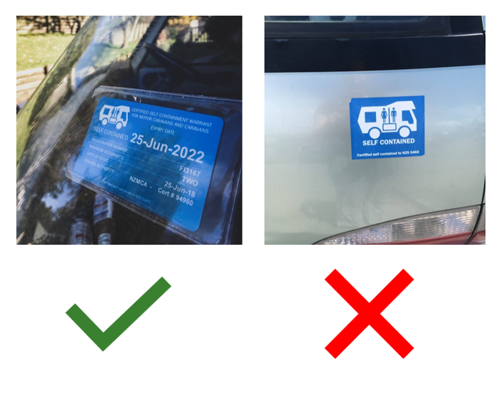
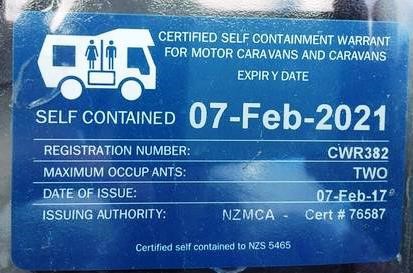
No, a Certified Self-Contained vehicle will display a current warrant card on the front left bottom windscreen, which will include the lawful number allowed to sleep in the vehicle.
-
The Plumbers, Gasfitter and Drainlayers Board (PGDB) is the regulator of the self-contained vehicles system. Information on what is needed to certify your vehicle (including answers to technical questions), and where to go to get certified, is available on the PGDB website.
-
Only vehicles that have a fixed toilet can obtain a self-containment certification (issued with green warrants).
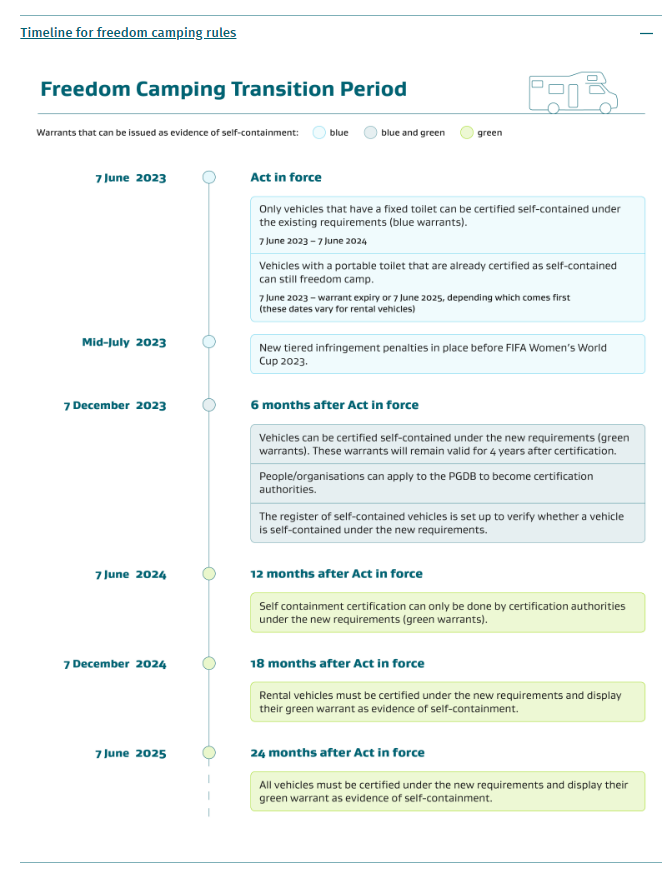
Vehicles already certified with a blue warrant (issued under the old requirements) can still freedom camp on local authority land (unless it is specifically prohibited), until your blue warrant expires, or 7 June 2026 (whichever happens sooner). After that, the vehicle owner must seek a new certification.
The Plumbers, Gasfitters and Drainlayers Board is the regulator of the self-contained vehicle system. See their website for information on what is needed to certify your vehicle, where to go to get certified and information for organisations looking to become certification authorities.
- Self-contained vehicles (external link) — Plumbers, Gasfitters and Drainlayers Board
- Camping in New Zealand (external link) — Tourism Industry Aotearoa
-
-
To report non-urgent issues including poor behaviour, such as rubbish dumping or illegal parking, you can email services@qldc.govt.nz
On the go? The Snap Send Solve app can also be used to report these issues.
-
For urgent requests, such as reporting noise issues or campers using non self-contained vehicles, phone 03 441 0499 (QT) or 03 443 0024 (Wka)– available 24/7. When reporting issues the more information you can provide is helpful for Enforcement Officers; vehicle registration, colour/make and details of specific locations.
-
For escalations relating to alcohol or if you witness anti-social behaviour, please report it to the police using the 105 Police Non-Emergency number.
-
For irresponsible driving call 555 to report road incidents which are urgent but not life-threatening.
-
Fire and Emergency NZ will respond to fires on reserves. If you see smoke or fire, please call 111 immediately.
-
-
Please call QLDC to report the issue on 03 441 0499 – we provide 24/7 assistance.
You can also use the Snap, Send & Solve app, a simple and free way to send QLDC non-urgent 'Fix It' requests.
Temporary prohibition at Allenby Place
-
QLDC has extended the temporary prohibition on freedom camping at Wānaka’s Allenby Place car park, exercising clause 9.1 of the QLDC Freedom Camping Bylaw 2025. The new prohibition will remain in place until 31 January 2027.
-
No. The prohibition remains temporary. However, the extension gives Council time to fully assess whether Allenby Place is suitable for freedom camping in the long term and whether a permanent bylaw change should be considered.
-
QLDC Interim Chief Executive Michelle Morss has made the decision to continue the prohibition at Allenby Place until 31 January 2027.
Clause 9.1 of the Freedom Camping Bylaw 2025 gives the chief executive the ability to temporarily restrict or change the conditions in any restricted freedom camping area or temporarily prohibit freedom camping in any restricted freedom camping area, if the Chief Executive is satisfied in relation to the matters in section 11(2) of the Act.
-
The reasons for the temporary prohibition remain unchanged from the decision made in January 2026. These include ongoing access and health and safety concerns that are specific to the site, particularly the narrow accessway into the car park and high traffic movements during peak periods.
-
Yes. If Council decides to proceed with a bylaw amendment process, it could permanently remove (or introduce additional conditions) for the restricted freedom camping area at Allenby Place.
-
No. Based on how the bylaw has operated over the summer, the information we have shows that while there are community concerns about some freedom camping areas, these do not meet the legal threshold required under the Freedom Camping Act 2011 to investigate further prohibitions. Prohibitions can only be put in place to protect an area, maintain access, or ensure people’s health and safety. Council work is ongoing around how the bylaw operates, including looking at other tools and technology.
-
To help offset the removal of the three spaces at Allenby Place, three additional freedom camping spaces have been added at the Wanaka Recreation Centre for the same duration, as was done as part of the January 2026 chief executive decision.
-
Anyone freedom camping at the Allenby Place restricted freedom camping area during the temporary prohibition period will be fined $400.
-
The Freedom Camping Act 2011 allows freedom camping by default on most council land. Local bylaws give councils limited but important powers to manage freedom camping to protect areas, maintain access, and ensure health and safety. These powers are not available without a bylaw.
-
The bylaw has largely been effective in directing visitors to 15 designated freedom camping locations across the district and in keeping most residential streets free from freedom camping. Allenby Place, however, continues to present site-specific challenges.
-
Yes. Enforcement has been effective and since 1 December 2025 council officers have issued 1,953 infringements of $400 under the Freedom Camping Act and 136 infringements of $800 under the Reserves Act 1977 as of 31 March 2026– sending a clear message that unlawful activity will not be tolerated.
-
Vehicles must have a valid warrant displayed to freedom camp showing that the vehicle is certified as self-contained. This means a vehicle must have a toilet and campers must be able to live in the vehicle for three days without getting more water or dumping waste.
A valid self-containment certificate warrant card must be displayed on the front left bottom windscreen which will include the lawful number allowed to sleep in the vehicle. Stickers found on the back of a vehicle DO NOT verify self-containment. Enforcement Officers check this for valid warrants on their night time patrols and issue infringements where appropriate.
-
Queenstown Lakes District is New Zealand’s most popular freedom camping destination. Since 1 December 2025, there have been 9,168 vehicle check-ins at designated freedom camping sites, as at 31 March 2026.
-
From 1 December 2025 to 31 March 2026, Council received over 932 requests for service from the public, mainly relating to noise, litter, non-compliance with site limits and requests for enforcement action.
-
A temporary freedom camping prohibition was put in place on 23 January 2026 to 30 April 2026.
-
Proposed next steps include:
16 April Council workshop - operation of the bylaw over summer, options for Allenby Place and other work streams.
25 June Council meeting - options report on a bylaw amendment.
23 July Council meeting - depending on decision at June meeting, adoption of statement of proposal and draft bylaw for consultation.
August - Consultation.
October - Hearings.
17 December - Council decision on a bylaw amendment.
-
Webpages you may like to read:
General FAQs
-
A self-contained vehicle must meet the Caravan Self Containment standard and be a Certified self-containment vehicle. You’ll need to be able to live in the vehicle for three days without getting more water or dumping waste. It must have:
-
A toilet
-
Fresh water storage
-
Waste water storage
-
A rubbish bin with a lid
-
A self-containment certificate warrant card displayed at all times
Please read about the new regulations now in place for certifying self-contained vehicles
For more information on how to be self-contained, head to New Zealand Motor Caravan Assocation CSC FAQs
-
-
Please note this section relates to parking activity not freedom camping.
Please read the carpark signs to confirm the time limits and requirements of each individual carpark area.
Large campervans are prohibited from parking in Queenstown’s town centre but 33 parking spaces are available specifically for campervans in the Boundary Street Carpark nearby. The Ballarat Street Carpark in the town centre also accommodates larger campervans. Please note that the Lakeview and Stanley Street Carparks have height restrictions restricting larger vehicles.
Large campervans are prohibited from parking in Queenstown CBD and certain parts of the Wanaka lakefront. Drivers could face an infringement of $70-$100 if parked incorrectly.
Smaller campervans such as Jucy or Wicked Campervans are permitted to park in the CBD as they are of similar size to an ordinary car.
Eight spaces are available at the Ramshaw Lane Carpark in Arrowtown.
Five spaces are available at the Mt Aspiring Road Carpark in Wānaka with plenty more in the parking lot near That Wanaka Tree and the Wānaka Watersports Facility.
Freedom camping in certified self-contained vehicles is allowed in 15 designated carpark sites across the district (which contain a total of 141 spaces). Camping in these areas is only permitted if the specific conditions for each site are followed.
-
You can find available campgrounds on the Campermate website or app, our Responsible Camping page and on the Tourism NZ website.
-
Dispose of rubbish at the transfer station in Frankton and Wānaka, and recycle with care at the Wakatipu Recycling Centre or Wānaka Wastebusters (fees apply).
Fines may be issued for rubbish dumping. Public litter bins should not be used for the disposal of campervan waste.
-
Campermate is a great source of locating services such as dump stations. Used water from sinks, showers, bath, laundry and chemical toilets must be dumped at a public dump station. There are public dump stations in Queenstown and Wānaka.
- BP Service Station, Frankton Road, State Highway 6, Frankton
- NPD Service Station, corner of State Highway 6 and Hawthorne Drive, Frankton
- Wānaka Showgrounds, corner of Brownston and McDougall Street, Wānaka
For a more detailed list showing public facilities such as dump stations across the district please view the interactive Responsible Camping Map at www.qldc.govt.nz/responsible-camping-map
-
Campermate is a great source of locating services such as dump stations. There are public dump stations in Queenstown and Wānaka.
Please see this video on how to use a campervan dump station for your wastewater
-
Campermate is a great source of locating services such as toilets and showers. If your vehicle is Certified Self-Contained, you should have your own toilet on board!
-
Campermate is a great source of locating services such as laundromats. If you stay in a registered camping ground, most of these will have their services on a pay-as-you-go basis.
-
If you are struggling to find suitable accommodation, please see our Manaaki page to help you find support.
If you are living in your vehicle, you are able to stay at dedicated campsites. You can find available campgrounds and facilities on the CamperMate website or app or on our Responsible Camping page.
If you are homeless and receive a freedom camping fine, you may be eligible for a waiver. You can request a waiver. These are assessed on a case-by-case basis
-
Check out this Adventue Smart video to see how you can stay safe as you journey through Aotearoa.